http://e-info.org.tw/node/117563
海洋酸化難生存 部分魚類全天候開啟夜間防禦機制
文字大小
119 1 Share1

本報2016年8月8日綜合外電報導,姜唯編譯;蔡麗伶審校
近期國際期刊《自然氣候變遷》研究指出,部分魚類為了適應全球暖化造成的海洋化學成分變化,當海水品質不利生存,即使是白天也會啟動夜間較強的生理防禦機制。
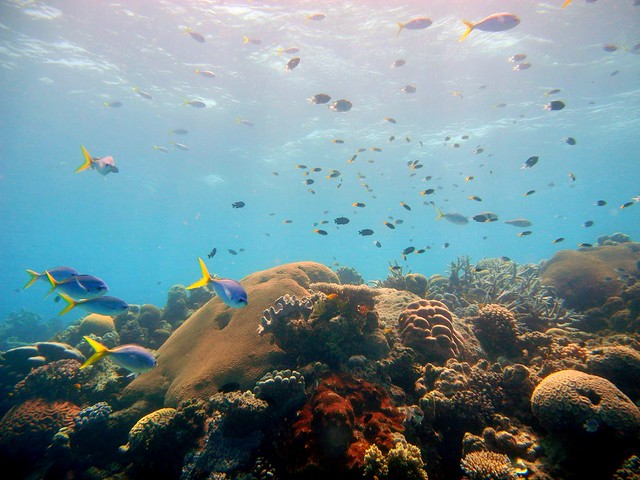
澳洲大堡礁的海底生態。圖片來源:郭兆揚提供。本報資料照片。
人類燃燒化石燃料釋放的二氧化碳,溶於水會使水質變酸,不利海洋生物生存。海水中的二氧化碳濃度日夜不同,夜間最高,白天則會隨著藻類、海草和其他植物行光合作用吸收二氧化碳而降低。隨著每天海水二氧化碳濃度變化,魚類也會跟著調節身體的防禦機制。
科學家研究澳洲大堡礁多刺鯛(spiny damselfish)發現,最能適應高濃度二氧化碳的個體,其後代的生理時鐘也較有彈性,較能適應海洋酸化。而「韌性較強的後代似乎可以全天候開啟夜間模式。」
科學家在二氧化碳濃度接近未來數十年狀態的海水中養灰色和白色雀鯛,並檢視其腦部的基因和蛋白質變化。另一位作者、澳洲詹姆士庫克大學學者孟迪(Philip Munday)表示,這是魚類能適應氣候變遷的另一個跡象,「也許」算是個好消息。此外還有很多氣候變遷相關的不利因素,如海溫上升,可能減少魚類繁殖活動。
2014年,聯合國氣候科學家小組指出,如果人為溫室氣體在本世紀升高至中高水準,「海洋酸化將是海洋生態的潛在威脅」。酸化不利扇貝或龍蝦的保護殼生長。其他研究發現酸化會改變鯊魚和鮭魚等各種魚類的行為。
【延伸閱讀】
【相關文章】
【參考資料】
Some fish tackle ocean global warming by pretending it's night
Date: 02-Aug-16
Country: NORWAY
Author: Alister Doyle;
Country: NORWAY
Author: Alister Doyle;

Tourists stand in front of huts that form part of the Lady Elliot Island Eco Resort where a turtle digs for food amongst the coral in the island's lagoon, north-east of the town of Bundaberg in Queensland, Australia, June 9, 2015.
Photo: DAVID GRAY
Photo: DAVID GRAY
Some fish may cope with the changing chemistry of the oceans linked to global warming by permanently setting their body defenses to night-time levels, the time of day when they find sea water least hospitable, a study said on Monday.
Man-made carbon dioxide, released into the air by burning fossil fuels, forms a weak acid when mixed with water that can harm marine life in what is likely to be a worsening effect of global warming this century.
Fish adjust their bodies every day because levels of carbon dioxide naturally in the seas peak at night and dip during sunlight hours when algae, seaweed and other plants absorb carbon dioxide to generate energy.
The study of spiny damselfish, a small species from Australia's Great Barrier Reef, found that those best able to tackle high carbon levels in the water produced offspring with flexible body clocks that helped adapt to acidification.
"It seems the tolerant offspring may have adjusted their circadian clocks as if it was always night," Timothy Ravasi, one of the authors at King Abdullah University of Science and Technology in Saudi Arabia, wrote of the findings published in the journal Nature Climate Change.
The scientists reared the grey and white damsel fish in water with levels of carbon dioxide comparable to those predicted for coming decades and examined changes in genes and proteins in their brains.
Philip Munday, another of the authors at James Cook University in Australia, told Reuters the findings were "potentially good news" by pointing to ways that fish can adapt to acidification.
But he said the scientists needed more study to see how far beneficial genes can be inherited. And there are also many other damaging factors linked to climate change, such as rising ocean temperatures that can stop some fish from breeding.
In 2014, the U.N. panel of climate scientists said that "ocean acidification poses substantial risks to marine ecosystems" if man-made greenhouse gas emissions rise at medium to high levels this century.
Acidification makes it harder for creatures such as scallops or lobsters to grow their protective shells. Other studies have found it can also disrupt the behavior of fish, from sharks to salmon.
(Editing by Richard Balmforth)


沒有留言:
張貼留言