http://e-info.org.tw/node/117750
躲過隕石撞地球卻不敵人類與浪犬 「溝齒鼩」今瀕絕
文字大小
1017 1 Share1
本報2016年8月16日綜合外電報導,姜唯編譯;蔡麗伶審校
身形大小如兔、長得像地鼠的「溝齒鼩」,堪稱為地表最強哺乳類,不但躲過6600萬年前導致恐龍滅絕的隕石災難,接下來的冰河期以及超級掠食者智人的出現,也沒能消滅溝齒鼩。然而,今日竟因人類活動和流浪狗而瀕臨滅絕。
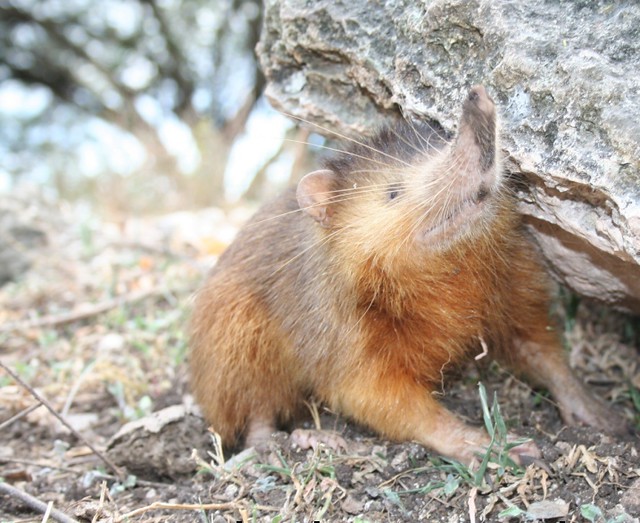
經歷過大風大浪的溝齒鼩可說是「活化石」,現在卻因人類活動瀕臨滅絕。圖片來源:維基百科 (CC BY-SA 3.0)。
白堊紀的「活化石」 學者:不可思議
溝齒鼩是一種大小如兔、長得像尖鼠的哺乳動物。目前只棲息在加勒比海地區,且只剩下海地溝齒鼩和古巴溝齒鼩兩個種。
「溝齒鼩是7800萬前從其他胎盤哺乳動物衍伸出來的,也就是說牠們從白堊紀就存在。」近期發表首本研究溝齒鼩線粒體DNA著作的科學家勃蘭特(Adam Brandt)說。不過在勃蘭特之前,已有兩個研究指出溝齒鼩很可能跟隨恐龍走上滅絕的道路。
「我們相當肯定,因為每個研究用的基因和親緣分析法都不同。」勃蘭特說,每個研究都讓結果更加確定。研究人員仍然並非百分百確定,隕石撞擊地球時溝齒鼩的分布狀況,不過科學家認為,當隕石撞擊墨西哥希克蘇魯伯時,溝齒鼩的數量應接近零。
「溝齒鼩能夠從這麼直接的衝擊倖存相當不可思議,當時全球的生態系統全部被破壞。我們不知道牠們怎麼做到的。」倫敦動物學會資深研究員特維(Samuel Turvey)說。
特維說,經歷過大風大浪的溝齒鼩可說是「活化石」,現在卻因人類活動瀕臨滅絕,實不勝唏噓。
瀕危物種排行榜居第七 溝齒鼩如今最怕被狗咬
溝齒鼩有許多奇怪的特徵,包括會分泌毒液的門牙,吻部中有球窩關節,非常靈活。牠們的眼睛很小,爪子很長,走起路來像醉漢,又似乎能用回聲定位法定位獵物。
夜行性的溝齒鼩住在洞穴中,夜間出來抓蠐螬和昆蟲,這樣的生活習慣可能過了7800萬年都沒不曾改變。不過,在現今,牠們出門不需擔心被蜥腳類踩到或是吵醒暴龍,卻要害怕賴以為家的森林遭人類砍伐,或是被流浪狗、貓鼬咬死。
目前,海地溝齒鼩已被世界自然保育聯盟列入瀕危物種,不過其下已經有兩種亞種接近滅絕。古巴溝齒鼩更慘,不只列入瀕危,更多次被科學家警告有滅絕危機。倫敦動物學會將兩種溝齒鼩列為哺乳類滅絕危機排行榜的第七名。
棲息地因採礦幾砍伐殆盡 保育成關鍵
英國《衛報》記者漢斯(Jeremy Hance)近日發表專欄文章,介紹海地溝齒鼩的處境尤其危險。海地的森林幾個世紀以來因為開採煤礦幾乎砍伐殆盡,現在海地溝齒鼩只棲息在海地最後一處雲霧森林奥特山。但是現在奧特山也受煤礦貿易影響,連馬卡亞國家公園都被煤礦業者滲透。
漢斯感嘆,動物的人氣和所能獲得的保育資源息息相關。有名的動物容易募得保育資金和引起公眾注意。倫敦動物學會曾和多明尼加政府合作啟動三年海地溝齒鼩保育計畫,但最後無疾而終。
漢斯呼籲人們注意物種保育的其他面向,像是滅絕風險、演化特殊性或生態角色。因為,溝齒鼩的時間已經不多了。

Dinosaur-surviving mammal endangered by stray dogs
Research shows the solenodon evolved more than 70 million years ago – in time to hang out with dinosaurs. But today these unique mammals face a barrage of threats including stray dogs, feral cats, invasive mongoose and deforestation.

If there was any justice in the animal kingdom – any at all – the solenodon would be as famous as the tiger. The solenodon is a rabbit-sized, shrew-like mammal that is only found on two Caribbean islands: Cuba and Hispaniola (the Dominican Republic and Haiti).
There are a whole slew of reasons why the solenodon’s star should rise, including the facts that it’s one of the only venomous mammals and David Attenborough really likes it. But, most of all, the solenodon should be famous because it somehow survived the asteroid collision that killed off the dinosaurs, not to mention the next 66 million years of other catastrophes, from Ice Ages to the rise of bipedal destroyers named Homo Sapiens.
“The solenodon lineage diverged from other placental mammals circa 78 million years ago. That means [it] has existed since the Cretaceous period,” said Adam Brandt, lead author of a recent study that took the first look at the solenodon’s mitochondrial DNA.
But Brandt’s research was actually the third study to find that solendons very likely scuttled under the feet of dinosaurs.
“We can be fairly confident because each of these studies have utilized different genes and phylogenetic analysis methods,” Brandt said, noting that with each study the “result becomes increasingly reliable.”
Researchers aren’t entirely sure where the various solenodon populations were located when the asteroid hit – whether they were already on the landmasses that would become modern-day Cuba and Hispaniola or on the mainland – but they think the populations were close to ground zero of the asteroid’s impact in Chicxulub, Mexico.
“It’s truly remarkable that the solenodons survived this direct hit, whilst global ecosystems collapsed around them – we have no idea how they did it,” Samuel Turvey, an expert on modern day extinctions and a Senior Research Fellow with the Zoological Society of London (ZSL), said.
Hello, Solenodon
There is really nothing on the planet like the solenodon. There are just two surviving species today, one found on Cuba and the other, more well known, on Hispaniola. But these two species alone are so distinct from any other mammal that they represent an entire biological family: Solenodontidae. To put that in perspective every single species of mice and rat – from the African pygmy mouse to the Northern Luzon giant cloud rat – also represent a single family of 700-plus species.

Solenodons sport a number of weird attributes. They can squeeze venomous saliva out of their incisors. They have evolved a ball and socket joint in their snout to give it extra-special maneuverability. They likely use echolocation to locate prey. Their eyes are tiny, their claws are in need of a trim, and they waddle when they walk as if they’d spent too much time at the pub.
Natural History Museum geneticist, Selina Brace, who recently co-authored a paper on the Hispaniolan solenodon with Turvey, called solenodons a “fabulously quirky creature” and said she was “instantly hooked” after seeing a picture of this oddity.
Nocturnal mammals, solenodons live in burrows and come out at night to eat grubs and insects, probably just as they did 78 million years ago, only now they don’t have to worry about being stepped on by a sauropod or waking a sleep-deprived tyrannosaur. Instead, these species must worry about having their forests chopped down by people or being eaten by a dog or a mongoose.
Currently the Hispaniola solenodon is considered endangered by the IUCN Red List – though two of its subspecies may be close to extinction. The Cuban solenodon is in an even more precarious position. Also considered endangered, the species has been feared extinct more than once. The ZSL’s EDGE Programme, which categorizes animals based on their threatened status and evolutionary distinctness, lists the pair of solenodons as number seven in the top 100 mammals.
Turvey said the fact that the solenodon survived so many upheavals “makes it even more tragic that these ‘living fossil’ survivors are now in danger of extinction due to human activities.”
Cuba’s star
Norvis Hernandez, a Cuban biologist, is one of the few people on planet Earth who has seen a living, wild Cuban solenodon. Smaller than its Hispaniola cousin, the Cuban solenodon is easily distinguished by its black-and-white hair.
“This experience of watching this ancient species [was] wonderful, it was for a short time because I do not like to feel that this species[was] stressed,” said Hernandez who caught a female solenodon in Alejandro Humboldt National Park for brief study before releasing it again. “I cannot explain what I felt the first time I touched it.”
It took Hernandez and her colleagues 12 days of searching in the field to finally catch a Cuban solenodon, known locally as the almiqui.
She said that the Cuban solenodon’s keen senses of smell and hearing make it almost impossible to capture with conventional methods. The species not only avoids human contact but, according to Hernandez, is never tricked by the mechanical traps scientists commonly use to catch small mammals.
First described in 1861, scientist lost track of the Cuban solenodon near the end of the 19th Century. No one had saw it for almost a hundred years – and many assumed it was extinct – until researchers spotted a few in the mid-1970s. And then no one saw it again until 2003.
Today, scientists have confirmed there is a small population hanging on in Alejandro Humboldt National Park. But no one knows how many or if its range extends beyond the park’s borders.
Hernandez, whose current work is funded through the Mohamed bin Zayed Species Conservation Foundation, said research of this endangered species has suffered due to a lack of money, including for non-invasive observation tools like camera traps.
“I think a lot remains to be done to preserve the species,” she said, adding that many local people don’t even know it exists or erroneously believe it is extinct.
Three-in-one solenodons
Even as scientists try and find out basic data on the Cuban solenodon, researchers are discovering surprises regarding the better-known Hispaniolan species. Surveying the species’ various populations, Samuel Turvey and his team recently discovered that the Hispaniolan species is actually three distinct subspecies.

“[These] evolved as a result of local isolation in the island’s geologically complex landscapes,” Turvey said, who noted the subspecies can be told apart both through DNA and physical attributes.
One subspecies is found in a single forest in Haiti and may be perilously close to extinction. Another is found throughout the bulk of the northern Dominican Republic, but is lesser known. The third is located across the southern Dominican mountain range – Sierra de Bahoruco – that includes several parks and is the best protected of the subspecies.
However, the discovery complicates conservation of the species as the southern subspecies show very little genetic diversity, while the northern subspecies survives in a highly fragmented landscape. According to Global Forest Watch, the Dominican Republic lost more than 200,000 hectares of forest between 2001 and 2014.

Despite having the largest range, Ernst Rupp, a Dominican Republic biologist with the local NGO Grupo Jaragua, said the northern subspecies “has never really been investigated.” However, recent surveys have proved the northern subspecies does still occurs in at least four protected areas, as well as in several areas outside protection.
The plight of the solenodon in Haiti may be the most dire of all. Haiti’s forests have been decimated over centuries and the solenodon survives only in the Massif de la Hotte region, the impoverished nation’s last significant stand of cloud forest.
“The Massif de la Hotte is a spectacular mountainous area in the far south-west of Haiti, where one of the few remnants of good quality forest in the country can be found,” said Rosalind Kennerley with Durrell Wildlife Conservation Trust (DWCT).
But, the region remains under intense pressure for the charcoal trade, which has resulted in almost total deforestation in Haiti. Even the national park – Macaya National Park – is commonly infiltrated by charcoal producers.
Kennerley is leading a team attempting to get baseline information on the how the Haitian subspecies if faring, a project also supported by the Mohamed bin Zayed Species Conservation Fund, which often gives grants to lesser-known species. Not only do solenodons face environment deterioration in Haiti, but locals will also kill them and eat them when they are found.
The perils of anonymity
Fame or the lack of it really does make a difference when it comes to conservation.
In 2009, a number of conservation groups – DWCT, ZSL’s the EDGE programme, La Sociedad Ornitológica de la Hispaniola (SOH) and the Dominican Republic’s Ministry for Environment and Natural Resources – kick-started a three-year research and conservation programme on the Hispaniola solenodon called The Last Survivors (the program also included the Hispaniola hutia, a tree-dwelling rodent). While it resulted in researchers learning more about the solenodon than ever before, the conservation impacts have been negligible, according to Rupp.
“[The programme] drew a lot of international attention to the Hispaniolan solenodon,” Rupp said. “Some of this attention actually spilled over into the Dominican press which published a few articles on the species.”
But the press has dissipated since the program ended in 2012 after a two-day stakeholder meeting. Worse still, few of the project’s conservation recommendations have come to pass.

“If there have been such activities after the termination of the project, they must have been very secretive,” Rupp said, noting that lack-of-funding probably sunk many of the recommended actions.
But Turvey said the Last Survivors Programme made considerable progress on the Hispaniolan species, including surveys across the Dominican Republic that found the species has a larger range than expected. As a result, the species will likely be downlisted by the IUCN Red List in the future. The programme’s work has also led to a new focus – and concern – for the nearly extinct subspecies in Haiti.
“Protection of the native-forest habitat remains a priority for this species, as it is for other species on Hispaniola,” Turvey said.
But there remains little pride or even knowledge of the species in his home country, according to Rupp, despite it being one of only two endemic land mammals across the entirety of Hispaniola and the fact that it actually walked with dinosaurs.
Sure, fame isn’t everything. In fact, for human beings fame may well bedetrimental for well-being. But for species, unfortunately, fame can mean the difference between extinction and survival. Famous species rake in far more funding and attention than the millions that live out of the limelight. While hopefully one day we’ll focus more on other attributes for species conservation – extinction risk, evolutionary distinctness, or ecological roles – solenodons may not have much time, especially the Haitian subspecies and the Cuban species.
Sure, solenodons survived the dinosaurs, the asteroid, several invasions of humans, and the arrival of novel predators – but can they survive obscurity in the Anthropocene?


沒有留言:
張貼留言