http://e-info.org.tw/node/117552
碳排量居高不下 2015年各項氣候指標皆破紀錄
文字大小
102 1 Share1
本報2016年8月5日綜合外電報導,姜唯編譯;蔡麗伶審校
去(2015)年是史上最熱的一年,年度地表溫度比2014年的紀錄還要高0.1°C,已經比前工業時代高出1°C;此外,大氣與海洋溫度、海平面高度和二氧化碳濃度等各項氣候變遷指標皆來到歷史新高。
聯合國已經警告,繼聖嬰現象帶來連續14個月的熱浪後,2016年均溫很可能再次破紀錄。
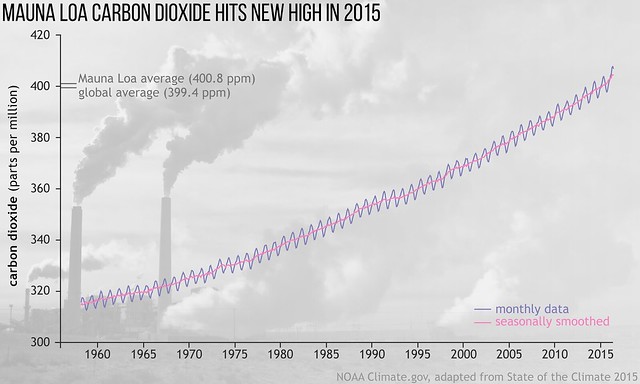
「氣候狀態」(state of the climate)報告顯示,全球二氧化碳濃度逼近400ppm。圖片來源:NOAA。
二氧化碳排放仍是主因 全球年均濃度逼近400ppm
美國國家海洋大氣管理局(NOAA)集結了62國、數百位科學家的研究,發表「氣候狀態」(state of the climate)報告指出,二氧化碳排放量增加,是這些氣候變遷現象的主因。
海洋吸收了90%多餘二氧化碳,溫度也創新高,突發高溫出現在聖嬰現象最明顯的東太平洋,比長期平均還高2°C。北極8月溫度甚至比平均還高8°C。
海洋溫度上升加上冰河融化,讓2015年創下海平面新高,比1993年首次以衛星測量海平面時還高了70公釐。海平面以每年3.3公釐的幅度升高,以西太平洋和印度洋升高速度最快。
夏威夷毛納基天文台去年測量到的二氧化碳濃度已超過了400ppm。根據NOAA的報告,全球二氧化碳濃度為399.4ppm,僅略低於夏威夷毛納基天文台所測數值,比2014年高了2.2ppm。
NOAA指出,2015年其他的歷史紀錄包括2月時北極海冰量創37年新低,全球高山冰川連續第36年淨減少,格陵蘭冰蓋表面融化超過50%,一旦完全崩解可使海平面上升七公尺。
氣候巨變 嚴重威脅人類與其他物種
氣候快速變遷可能嚴重影響人類和其他物種。去年6月,一波嚴重熱浪導致巴基斯坦1000人死亡。嚴重乾旱導致衣索比亞數百萬人糧食短缺,降雨減少導致印尼多地點大規模森林大火,產生更多的溫室氣體。
海冰消失使海象往陸地移動,獅子魚科和極地鱈魚等北極海洋物種被南方遷徙來的物種排擠,北美西岸藻類大規模增生威脅海洋生物和漁獲。
科學家表示,去年的氣候變遷現象,因為聖嬰現象而雪上加霜。這股赤道太平洋暖水影響了全世界的氣候,並助長了2016年的炎熱高溫。
NOAA環境資訊中心主任卡爾(Thomas Karl)指出,去年的氣候受到長期氣候變遷和聖嬰現象的雙重影響,建立氣候韌性必須兩種因素都必須考量在內。
「去年的聖嬰現象告訴我們,短期的氣候事件可能增加長期暖化趨勢的衝擊。」

Environmental records shattered as climate change 'plays out before us'
Temperatures, sea levels and carbon dioxide all hit milestones amid extreme weather in 2015, major international ‘state of the climate’ report finds

The world is careening towards an environment never experienced before by humans, with the temperature of the air and oceans breaking records, sea levels reaching historic highs and carbon dioxide surpassing a key milestone, a major international report has found.
The “state of the climate” report, led by the National Oceanic and Atmospheric Administration (Noaa) with input from hundreds of scientists from 62 countries, confirmed there was a “toppling of several symbolic mileposts” in heat, sea level rise and extreme weather in 2015.
“The impacts of climate change are no longer subtle,” Michael Mann, a leading climatologist at Penn State, told the Guardian. “They are playing out before us, in real time. The 2015 numbers drive that home.”

Last year was the warmest on record, with the annual surface temperature beating the previous mark set in 2014 by 0.1C. This means that the world is now 1C warmer than it was in pre-industrial times, largely due to a huge escalation in the production of greenhouse gases. The UN has already said that 2016 is highly likely to break the annual record again, after 14 straight months of extreme heat aided by a hefty El Niño climatic event, a weather event that typically raises temperatures around the world.
The oceans, which absorb more than 90% of the extra CO2 pumped into the atmosphere, also reached a new record temperature, with sharp spikes in the El Niño-dominated eastern Pacific, which was 2C warmer than the long-term average, and the Arctic, where the temperature in August hit a dizzying 8C above average.

The thermal expansion of the oceans, compounded by melting glaciers, resulted in the highest global sea level on record in 2015. The oceans are around 70mm higher than the 1993 average, which is when comprehensive satellite measurements of sea levels began. The seas are rising at an average rate of 3.3mm a year, with the western Pacific and Indian Oceans experiencing the fastest increases.
These changes are being driven by a CO2 concentration that surpassed the symbolic 400 parts per million mark at the Mauna Loa research station in Hawaii last year. The Noaa report states that the global CO2 level was a touch under this, at 399.4ppm, an increase of 2.2ppm compared to 2014.

Noaa said other “remarkable” changes in 2015 include the Arctic’s lowest maximum sea ice extent in the 37-year satellite record, recorded in February 2015. The world’s alpine glaciers recorded a net annual loss of ice for the 36th consecutive year and the Greenland ice sheet, which would balloon sea levels by around 7m should it disintegrate, experienced melting over more than 50% of its surface.
The rapid changes in the climate may have profound consequences for humans and other species. In June last year, a severe heatwave claimed over 1,000 lives in Karachi, Pakistan. Severe drought caused food shortages for millions of people in Ethiopia, with a lack of rainfall resulting in “intense and widespread” forest fires in Indonesia that belched out a vast quantity of greenhouse gas.
Diminishing sea ice is causing major walrus herds to haul themselves out on to land. Arctic marine species, such as snailfish and polar cod, are being pushed out of the region by species coming from further south, attracted to the warming waters. A huge algal bloom off the west coast of North America harmed marine life and fisheries.

Scientists have said there were underlying climate change trends at play but last year was also influenced by the strong El Niño event, which is when equatorial Pacific waters warm, leading to an array of weather effects around the world. El Niño has also helped spur searing heat in 2016 but has now petered out.
Thomas Karl, director of Noaa national centers for environmental information, said that last year’s climate “was shaped both by long-term change and an El Niño event. When we think about being climate resilient, both of these time scales are important to consider.
“Last year’s El Niño was a clear reminder of how short-term events can amplify the relative influence and impacts stemming from longer-term warming trends.”
Kate Willett, a senior scientist at Britain’s Met Office, said that there was a 75% annual increase in the amount of land that experienced severe drought last year.
“Looking at a range of climate measurements, 2015 was yet another highly significant year,” she said. “Not only was 2015 the warmest year on record by a large margin, it was also another year when the levels of dominant greenhouse gases reached new peaks.”
The state of the climate report is now in its 26th year. The peer-reviewed series is published annually by the American Meteorological Society.


沒有留言:
張貼留言