http://e-info.org.tw/node/116131
西伯利亞「冥界之門」天坑變大 學者:全球暖化徵兆
文字大小
1448 1 Share1
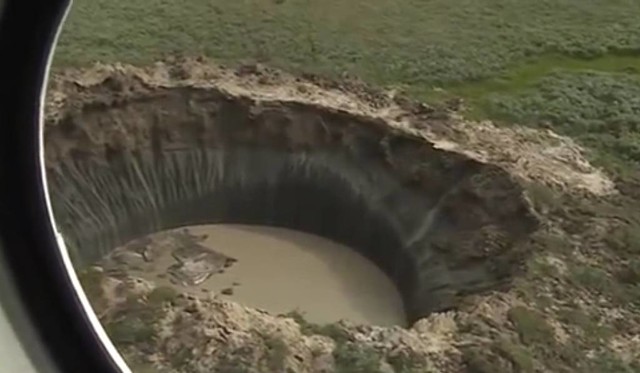

本報2016年6月14日綜合外電報導,姜唯編譯;蔡麗伶審校
西伯利亞冰封內陸25年前突然出現的巨大天坑,恐懼的當地人稱為「冥界之門」,不敢靠近。近來科學家發現,這全世界最大的天坑「Batagaika」是氣候暖化的徵兆,北半球各地也陸陸續續出現較小的天坑。
全世界最大的天坑「Batagaika」正在快速擴張。圖片來源:EEAARRTTHHDDUUMM影片截圖。
當地人的恐懼不是沒有道理。由於永凍土融化,「Batagaika」正快速擴張,已經達1公里長、90公尺深,每年寬度增加20公尺,走在邊緣就已經相當危險。
永凍土融化是人類文明最大的恐懼之一,因為會釋出大量的甲烷——其溫室效應比二氧化碳強得多。如果暖化溫度超過4°C,導致永凍土全數融化,全球將會陷入難以形容的恐怖災難。
英國薩塞克斯大學地質學教授默頓(Julian Murton)實地走訪Batagaika天坑後指出,該天坑含有20萬年前的地質資訊:「Batagaika幫助我們瞭解過去發生過,以及未來可能發生的事。隨著氣候暖化,融化的永凍土會越來越多,這類冰融喀斯特地形也會越來越普遍,天坑、溝蝕和土壤表面侵蝕更會越來越常見。許多證據顯示,過去幾十年來,北半球的冰融喀斯特地形的規模和強度都在增加。」
不過,西伯利亞要快速融化還要一段時間。目前當地溫度仍可達-68°C的低溫。
Batagaika天坑據稱是1980年代或1990年代初期當地人砍樹後形成的。
「永凍土上的植被或土壤被擾動後產生連鎖效應,導致永凍土中的冰融化。移除植被就像移除了隔熱層,讓夏季的熱能深入地底。」默頓說。
天坑不但邊緣相當危險,底部也像是災難電影的場景。默頓將天坑底部比做美國西南部的惡地,充滿深溝,甚至可看見猛獁象、麝香牛和馬的遺骸和古代樹幹。
不過默頓說,倒是沒有看到什麼通往冥界的路。
【相關文章】
【參考資料】
- 英國獨立報(2016年6月3日),Appearance of crater dubbed ‘the Gateway to the Underworld’ in Siberia is a warning to our warming planet
※ 本文與 行政院農業委員會 林務局  合作刊登
合作刊登
合作刊登Appearance of crater dubbed ‘the Gateway to the Underworld’ in Siberia is a warning to our warming planet
Such slumps have been ‘increasing in extent and intensity’ in the frozen north, scientists say
|
|
|
|


It is known as “the Gateway to the Underworld” by local people who fear to go near the massive crater that suddenly appeared in the frozen heart of Siberia.
And they are right to be afraid.
For as the permafrost melts, the world’s biggest “megaslump” is expanding rapidly. Already about a kilometre long and 90m deep, it is widening by up to 20m a year, making walking near its precipitous edges a dangerous pursuit.
But Batagaika crater, which first appeared about 25 years ago, is also a sign of the rate at which the world is warming – smaller ones have been appearing increasingly across the northern hemisphere.
The melting of the permafrost represents one of humanity’s greatest fears for it contains vast amounts of methane, a greenhouse gas much more potent than carbon dioxide.
If it were all to melt – a process that would start on an epic scale after about four degrees of warming – it would likely tip the planet into an extreme scenario the full horror of which is hard to describe.
Professor Julian Murton, a geologist at the University of Sussex, has just returned from a trip to the crater to study its cliffs, which provide a new source of geological information that potentially dates back some 200,000 years.
This includes the last time that the Earth was warmer than it is now, when hippopotamuses and elephants wandered around the future Trafalgar Square.

The crater, 1km long and 90m deep, has appeared in the past 30 years (Julian Murton)
Professor Murton said: “In some sense, Batagaika does provide a view to what has happened in the past and what is likely to happen in the future.
“As the climate warms – I think there’s no shadow of a doubt it will warm – we will get increasing thaw of the permafrost and increasingly development of these ‘thermokarst’ features. There will be more slumps and more gullying, more erosion of the land surface.
“I think there’s growing evidence over the last few decades that thermokarst activity in the northern hemisphere has been increasing in extent and intensity.”
However, it will be sometime before Siberia begins to melt dramatically. It can still experience temperatures as low as minus -68C.
The Batagaika crater is thought to have begun after local people cut down some trees in the 1980s or early 1990s.
“Once you disturb the vegetation or soil above permafrost that can often set in train events that lead to the melting of ice within the permafrost,” he said.
“Cutting down of vegetation … removes some of the insulation that keeps the ground cool and that allows the summer heat to penetrate deeper into the ground.”
While the cliff edges are treacherous, the bottom of the crater is also something of a horror show.
Professor Murton compared it to the Badlands of the south-west US, full of ravines and gullies.
The remains of animals such as mammoths, musk ox and horses and ancient tree stumps can also be seen.

However, Professor Murton confirmed he had not found any sign of a mysterious tunnel leading to an underworld, physical or spiritual.
“At the bottom of the slump is rock … I haven’t seen any gateway to hell,” he said.
And while the permafrost can contain large amounts of methane, Professor Murton said there was “probably not a lot” in this particular area.
“You need waterlogged conditions for generating methane. It is pretty wet in the bottom of the slump, so it’s possible there’s some methane coming out of there,” he said.
But the crater, he said, was dangerous to people in the area simply “because this thing is growing remarkably quickly”.
“If you’ve got roads or paths nearby, they could easily get consumed as this thing grows … so it poses a hazard to the locals,” he said.
“There’s a lot of underground ice, ice wedges that are 20 to 30 metres high. Once this starts thawing there will be rapid change.”
- More about:
- permafrost
- Sibera
- climate change
- Global Warming
|
|
|
|


沒有留言:
張貼留言