


DAISY DUNNE
30.04.2019 | 2:06pm
WILDLIFEClimate change could ‘raise stress levels’ of endangered mountain gorillas
Global warming could cause stress to endangered Virunga mountain gorillas, potentially raising the risk of health problems and early death, a new study suggests.
Using fecal samples taken in the wild, researchers found that Virunga gorillas show elevated stress levels in months with higher-than-average temperatures and rainfall.
This suggests that Virunga gorillas “might be more sensitive to warming trends than previous research has suggested”, the authors write in their research paper.
The findings provide “robust” evidence of how climate change could heighten the animals’ stress levels, a primatologist tells Carbon Brief. “We don’t know yet what the long-term impact of this physiological response will be, but it could be a harbinger of reduced survival or fertility.”
On edge
Mountain gorillas (Gorilla beringei beringei) are an endangered subspecies living in fragmented forests across the Great Lakes region of Africa.
The total population of around 1,000 individuals is split between two regions. The term “Virunga mountain gorilla” refers to the group that live across the Virunga massif, a chain of volcanoes covered by dense cloud forest. The region spans Rwanda, Uganda and the Democratic Republic of Congo.
Virunga gorillas face severe ongoing threats from hunting, habitat destruction and the impacts of nearby human conflicts. However, major conservation efforts have seen population numbers rise from around 250 in the 1980s to 604 in 2016.
The new study, published in the journal Ecology and Evolution, gives an idea of how current threats might be compounded by future climate change.
Over two years, researchers routinely collected fecal samples from 115 Virunga gorillas. This allowed them to continuously monitor the animals’ stress hormone(glucocorticoid) levels.
The scientists then compared these results to local records of monthly temperature and rainfall data. They also considered a range of social factors that can influence stress levels, including gorilla group size and proximity to rival groups.
Heat stress
The findings show that baseline stress levels of Virunga gorillas were raised in months with higher-than-average maximum and minimum temperatures, as well as in months with higher rainfall.
The chart below, which is taken from the paper, shows monthly average stress hormone levels for different gorillas plotted against monthly rainfall totals (black dots). The blue line indicates that there is a positive relationship between the two.
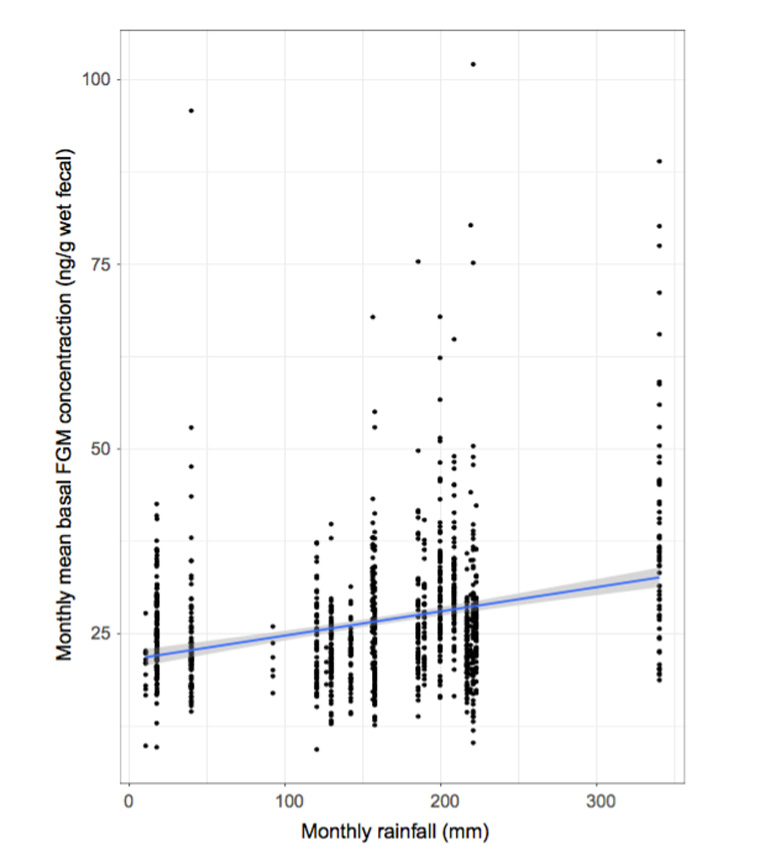
The relationship between monthly rainfall and baseline stress hormone levels for Virunga mountain gorillas. Source: Eckardt et al. (2019)
The researchers did not study the reasons why gorillas might have experienced more stress in warmer or wetter conditions.
However, the researchers note that “on hot and sunny days, mountain gorillas often seek shade in vegetation”, leading to “reduced time spent feeding”. The research paper adds:
“Their black hair may increase the risk of experiencing thermal stress, as has been shown in equator-dwelling goats with dark coat colours.”
When rain is heavy, “mountain gorillas sit still in a huddle, but if rain persists, they will resume feeding and compensate for lost feeding time”, the authors say. This could raise stress as “gorillas work harder to maintain a stable body temperature” to counteract the rain’s cooling impact.
Restricted
The findings suggest that Virunga gorillas “may have a harder time coping with warmer temperatures and more extreme rainfall”, the authors say:
“Mountain gorillas might be more sensitive to warming trends than previous research has suggested, since their small habitat restricts their ability to seek out colder temperatures.”
Local temperatures in the gorillas’ habitat could increase by up to 3.6C by 2090, relative to 1990 levels, under a moderately high greenhouse gas emissions scenario (SRES A2).
In addition, rainfall is expected to become “less evenly distributed”, with “more extreme swings between the wet and dry seasons”, the authors say.
It is not yet known how additional stress could impact survival for gorillas, the authors say. However, it could “negatively affect health, reproductive rates and mortality”.
The research paper presents “very clear results”, says Prof Susan Alberts, a primatologist and chair of evolutionary anthropology at Duke University, who was not involved in the study. She tells Carbon Brief:
“The methods are clear and straightforward, the sample size is large and so the results seem quite robust. Of course, we don’t know yet what the long-term impact of this physiological response will be, but it could be a harbinger of reduced survival or fertility.”
Even if the impact of climate change on stress levels does not lead to population declines, it is likely to compound the other threats faced by gorillas, the authors add in their research paper:
“Multiple factors acting simultaneously may profoundly change the amount of physiological stress experienced by the average individual, which could have both short-term and long-term detrimental effects on population size.”
Eckardt, W. et al. (2019) Social and ecological factors alter stress physiology of Virunga mountain gorillas (Gorilla beringei beringei), Ecology and Evolution, https://doi.org/10.1002/ece3.5115


沒有留言:
張貼留言