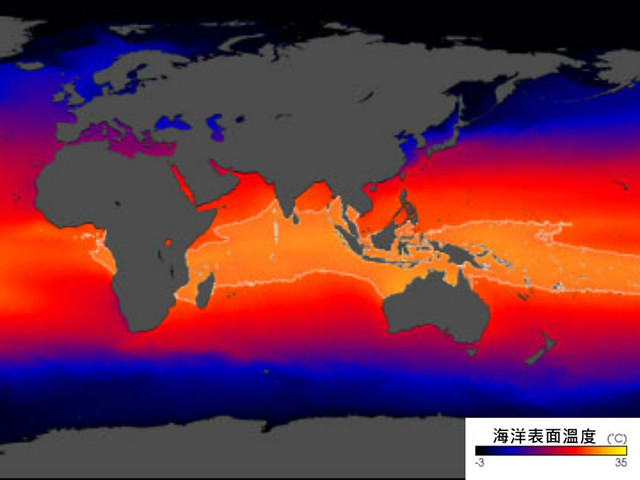
Greenhouse gas emissions have led to an increase in the size and temperature of the ‘Indo-Pacific Warm Pool’, the largest area of warm water in the world, scientists have warned.
The pool stretches about 9,000 miles along the equator and 1,500 miles from north to south. It is defined as an area of ocean with an average temperature of more than 28 degrees Celsius but this can reach up to 30 degrees in places.
As water warms, it expands and the region has experienced the “world’s highest rates of sea-level rise” in recent years.
Five small islands in the South Pacific
recently disappeared and six others were partially destroyed by the rising tide.
And because the warmth of the water can drive moisture and hot air high into the atmosphere, it has a significant effect on the weather experienced by countries in the region, increasing the risk of severe cyclones.
However the researchers, from South Korea, Australia, Canada and China, said overall it had warmed by 0.3C and increased in size by about a third over the last 60 years.
While the temperature rise may sound small, the pool’s size means the amount of extra energy is vast.
In a paper in the journal
Science Advances, they wrote: “The IPWP (Indo-Pacific Warm Pool) is Earth’s largest region of warm sea surface temperatures, has the highest rainfall, and is fundamental to global atmospheric circulation and hydrological cycle.
“The region has also experienced the world’s highest rates of sea-level rise in recent decades, indicating large increases in ocean heat content and leading to substantial impacts on small island states in the region.”
The researchers compared measurements of temperature with climate simulations and concluded that greenhouse gases were “the dominant cause of the observed increases in IPWP intensity and size, whereas natural fluctuations associated with the Pacific Decadal Oscillation have played a smaller yet significant role”.
“Human-induced changes in the IPWP have important implications for understanding and projecting related changes in monsoonal rainfall, and frequency or intensity of tropical storms, which have profound socioeconomic consequences.”
Paris climate talks in pictures
Professor Seung-Ki Min, of Pohang University in South Korea, told The Independent that their research suggested only 12 to 18 per cent of the warming had occurred naturally with the rest caused by greenhouse gas emissions.
Apart from the increase in sea levels, this extra energy will also increase the severity of major storms.
“We expect the intensification of tropical cyclones because you have a larger area of hot water and the increase in temperature means the energy source is more,” Professor Min said.
They also found that if the Indian Ocean section of the warm pool expands more than the Pacific part, this leads to an increase in rainfall in the western Indian Ocean.
But if this is reversed, it tends to result in a decrease in rainfall over east Asia.



沒有留言:
張貼留言