http://e-info.org.tw/node/117175
每小時解決千隻蚊子 美小鎮蓋蝙蝠屋防茲卡
文字大小
1872 2 Share1

本報2016年7月20日綜合外電報導,姜唯編譯;蔡麗伶審校
《紐約時報》報導,隨著蚊子生長旺季到來,美國長島北亨普斯特德鎮(North Hempstead)決議要以蝙蝠來防治西尼羅河(West Nile)病毒和茲卡(Zika)病毒。
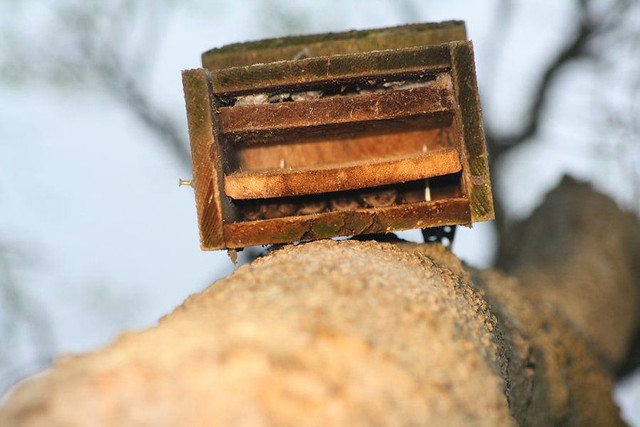
美國小鎮鼓勵民眾蓋蝙蝠屋,吸引蝙蝠入住。攝影:Joey Weber,Indiana State University。圖片來源:USFWSmidwest(CC BY 2.0)。
「蝙蝠每小時可吃掉1000隻蚊子。這可是任何殺蟲劑都做不到的。」鎮上官員柏絲沃(Judi Bosworth)說。
北亨普斯特德鎮2007年起開始鼓勵居民蓋蝙蝠屋,吸引蝙蝠入住,以減少殺蟲劑用量,目前已有數個公園內有蝙蝠屋。
一直以來人們對蝙蝠的印象不外乎晝伏夜出、會吸血。不過長島的蝙蝠並不吸血。石溪大學生態與演化學系副教授達瓦洛斯(Liliana M. Dávalos)說,美國紐約州有九種蝙蝠出沒,都不吸血。此外,據美國人道協會資料,北美會帶原狂犬病的蝙蝠不到0.5%。
達瓦洛斯指出,蝙蝠的飛行是劇烈的有氧運動,必須儲備大量熱量,並攝食熱量最高的獵物。蚊子熱量不算高,但是一旦進入蝙蝠行進路線就會被吃掉。
石溪大學傳染病專家唐闌(Susan Donelan)指出,長島有白線斑蚊(Aedes albopictus),而白線斑蚊在實驗室中會傳播茲卡病毒。不過目前長島還沒傳出感染茲卡的病例。茲卡要進入長島,最有可能的途徑是帶原者到當地被病媒蚊叮咬。
根據美國國家醫學圖書館的資料,同樣由蚊子傳染的西尼羅河病毒是在1999年進入美國。根據紐約州衛生部的資料,從2000年至去年10月,紐約州共出現490個感染病例,其中37人死亡。
因此,嗜吃蚊子的蝙蝠成了北亨普斯特德鎮的芳鄰。
不過蝙蝠屋的效果究竟如何呢?鎮上的環境控制專員布朗(Kevin Braun)說,「蝙蝠屋的效果難以量化。不過既然蝙蝠吃蚊子等飛蟲,蝙蝠屋越多自然蚊子越少。」
從事野生物工作坊的生物學家鮑爾斯(Eric Powers)說,「我們認為蝙蝠屋的確有用,因為全國所有有蝙蝠屋的地方都能觀察到蝙蝠忙著吃這些小飛蟲。」
【相關文章】
【參考資料】

NORTH HEMPSTEAD, N.Y. — As mosquito season heats up, bringing with it the threat of the West Nile and Zika viruses, one Long Island town is taking an unorthodox approach: bats.
The town, North Hempstead, has approved the construction of boxes that function as bat houses in several parks to attract more bats to the area.
“Bats can eat up to 1,000 mosquitoes per hour,” Judi Bosworth, the town supervisor, said. “That’s extraordinary. A pesticide couldn’t do that.”
The town started encouraging the building and hanging of bat houses in its parks in 2007 to curb the use of pesticides, and it has added a few more each year since.

“We have an increased sense of urgency in terms of wanting to make sure that we’re controlling the mosquito population to the very best of our ability,” Ms. Bosworth said, alluding to the viruses. “Just having bat houses isn’t going to be the answer, but at least it’s looking toward a solution that is environmentally friendly.”
Over the years, the Boy Scouts and Girl Scouts have chipped in and built some of the houses. This year, Yianni Biniaris, 16, from Manhasset, N.Y., hopes building, repairing and replacing bat houses at the Clark Botanic Garden here will help him attain the rank of Eagle Scout. His project has been approved by North Hempstead, but it still needs to be cleared by the Scouts.
“Using the bat houses is more of a friendlier way of getting rid of mosquitoes, while saving the bat population,” Yianni said last month at the garden, home to about 20 of the houses.
His mother, Stella Biniaris, said wanting to remove bats from behind the shutters of their house had led her son to the project.

“We went to get rid of them and my husband said: ‘You can’t get rid of them! You don’t understand, we need them!’” Ms. Biniaris recalled.
The myths surrounding bats have long shaped public perception of the night creatures.
“I grew up and I always heard, you know, these old wives’ tales, that bats will swoop down on your head and get tangled in your hair,” Ms. Bosworth, the town supervisor, said. “Bats really have been very maligned.”
As for drinking blood, the bats on Long Island do not partake. New York State is home to nine bat species — none of them vampire bats, according to Dr. Liliana M. Dávalos, an associate professor in the department of ecology and evolution at Stony Brook University.
And less than one-half of 1 percent of all bats in North America carry rabies, according to the Humane Society of the United States.

The “strenuous aerobic exercise” of flying, Dr. Dávalos said, requires bats to pack on calories, searching for the most caloric prey available. Mosquitoes are not necessarily the most caloric — they are on the lower end of that scale — but bats will eat the ones in their paths anyway, she said.
Aedes albopictus, known as the Asian tiger mosquito, is found on Long Island and is capable of transmitting Zika in a laboratory setting, said Dr. Susan Donelan, an infectious disease specialist at Stony Brook, which is part of the State University of New York system. So far, there have been no reported cases of local transmission of the disease, she said.
For Zika to reach Long Island, an infected person would probably have to come to the area and be bitten by a mosquito that can transmit it, Dr. Donelan said.
“Mosquitoes don’t travel long distances; people do,” she said. “It’s not like the mosquitoes from Brazil are flying up here and infecting us. It’s the people that are coming from those areas.”

The West Nile virus, which is also spread by mosquitoes, appeared in the United States in 1999, according to the United States National Library of Medicine. As of October, 490 cases of West Nile and 37 deaths resulting from it have been recorded in New York since 2000, according to theState Health Department.
So the bats, with their appetite for mosquitoes, make very welcome neighbors. “These bats have helped us for so many years, we are in their debt,” John Darcy, North Hempstead’s deputy parks commissioner, said.
But how helpful are the bat houses?
“The effectiveness of bat boxes is hard to quantify,” Kevin Braun, the town’s environmental control specialist, said. “But we know that bats eat flying insects, including mosquitoes, so it is not a great leap of faith to say that more bat boxes means more bats and less mosquitoes.”
Eric Powers, a biologist who conducts wildlife workshops, said, “We know that it works because of the myriad trials around the country where these boxes are in place and bats are busy eating their way through the bugs.”
At the Clark Botanic Garden last month, Mr. Powers said that in an ideal world, bats would live in dead trees with peeling bark, or in old barns.
“But here on Long Island, it’s such a dense population that the second that a tree is identified as diseased or aged, it’s cut down and removed,” he said. “We’ve eliminated all the places that they would like to hang out.”


沒有留言:
張貼留言