https://www.cbsnews.com/news/worlds-oceans-are-losing-oxygen-at-a-dangerous-unprecedented-rate-as-temperatures-rise/?fbclid=IwAR1MreCKnAUltXbZupa9LXwDN0FHYK_FD8ukQ7HQFL4rPrt4cS_ZSDOPW1c
World's oceans are losing oxygen at a dangerous, unprecedented rate as temperatures rise, study finds
The world's oceans are struggling to breathe, rapidly running out of oxygen at an unprecedented rate. Climate change is dangerously exacerbating the issue, scientists warned in a new study.

The International Union for Conservation of Nature (IUCN) released the largest report of its kind — combining the efforts of 67 scientists from 17 countries — at the global climate summit in Madrid on Saturday. It found that the oxygen level of the ocean has declined by about 2% since the 1950s, and the volume of water completely depleted of oxygen has quadrupled since the 1960s.
Sixty years ago, only 45 ocean sites suffered from low oxygen levels. That number skyrocketed to 700 in 2011. According to the study, about 50% of oxygen loss in the upper part of the ocean is a result of temperature increase.
"With this report, the scale of damage climate change is wreaking upon the ocean comes into stark focus," Dr. Grethel Aguilar, IUCN acting director general, said in a statement. "As the warming ocean loses oxygen, the delicate balance of marine life is thrown into disarray."
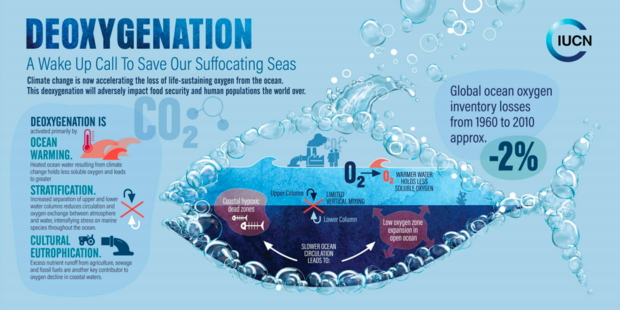
A combination of climate change and increased nutrient discharge will cause a 3%-4% decrease in ocean oxygen levels on average by 2100 if business continues as usual, scientists predict.
"This is perhaps the ultimate wake-up call from the uncontrolled experiment humanity is unleashing on the world's ocean as carbon emissions continue to increase," said Dan Laffoley, Senior Advisor Marine Science and Conservation in IUCN's Global Marine and Polar Program and a co-editor of the report.
Researchers named 2 major causes of deoxygenation
- Ocean warming from burning fossil fuels: Warmer oceans hold less oxygen and are more buoyant than cooler water. This makes it difficult for oxygen to make its way to deeper waters and raises the oxygen demands of sea creatures.
- Excessive growth of algae (eutrophication): Plant life is rapidly growing due to fertilizer run-off into waterways, sewage, animal waste, aquaculture and nitrogen deposition from the burning of fossil fuels. The increased plant life leads to a lack of oxygen and higher animal mortality rates.
Ocean deoxygenation has a wide range of consequences on marine biodiversity and the everyday functioning of ocean ecosystems.
"Whilst we have known about dead zones in the ocean for many decades, ocean warming is now expected to further amplify deoxygenation across great swathes of the ocean," said Isabella Lövin, Minister for Environment and Energy and Deputy Prime Minister of Sweden, a major funder of the report. "With this report it is time to put ocean deoxygenation among our top priorities in order to restore ocean health."
Reductions in oxygen levels in the ocean can cause stress in marine organisms, depriving them of the necessary oxygen supply. According to researchers, deoxygenation is threatening larger species including tuna, marlin, swordfish and sharks.
Larger marine animals are swimming closer to the surface, where oxygen is more available, but this leaves them prone to overfishing. Hundreds of millions of people who rely on fishing for their food and livelihood may be affected as they struggle to adapt.
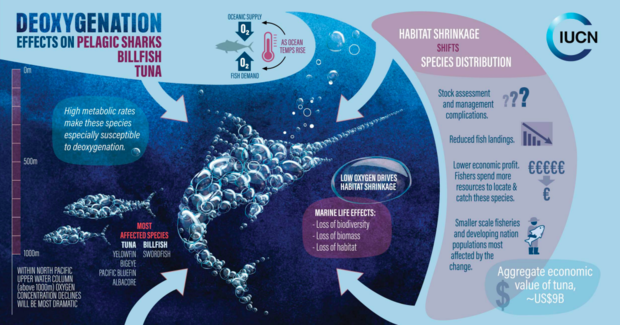
"If we run out of oxygen it will mean habitat loss and biodiversity loss and a slippery slope down to slime and more jellyfish," said IUCN Global Marine and Polar Programme director Minna Epps. "It will also change the energy and the biochemical cycling in the oceans and we don't know what these biological and chemical shifts in the oceans can actually do."
In addition to the socioeconomic impacts on humans, deoxygenated waters produce greenhouse gases, including carbon dioxide and methane, that are eventually released into the atmosphere. Greenhouse gas levels in the atmosphere reached a record high in 2018, according to the World Meteorological Organization.
In order to fix the issue of deoxygenation, scientists say humans must quickly tackle the climate crisis globally, as well as nutrient pollution at the local level through legislation to reduce runoff. Scientists warn that warming-driven deoxygenation cannot easily be reversed, but it can be slowed by reducing greenhouse gas emissions.
The report was released during COP25 because world leaders are crucial to changing outcomes for the oceans.
"Urgent global action to overcome and reverse the effects of ocean deoxygenation is needed," Epps said. "Decisions taken at the ongoing climate conference will determine whether our ocean continues to sustain a rich variety of life, or whether habitable, oxygen-rich marine areas are increasingly, progressively and irrevocably lost."


沒有留言:
張貼留言