‘It turned out to be a terrible mistake to assume that capitalism and democracy naturally go hand in hand.’
Capitalism reigns. But capitalism is in trouble. Therein lies the paradox of our age. For the first time in human history, a single economic system spans the globe. Of course there are differences between capitalism Chinese-style, American-style and Swedish-style. Close up, these differences can seem significant. But viewed through a wider lens, the distinctions blur. As the economist Branco Milanovic writes in his new book, Capitalism Alone, “the entire globe now operates according to the same economic principles – production organized for profit using legally free wage labor and mostly privately owned capital, with decentralized coordination”.
After the fall of Soviet communism in 1989, and China’s embrace of the market, crowned by the nation’s entry into the World Trade Organization in 2001, it seemed, for a brief flicker of human history, that the world was converging on a political economy of free markets in liberal democracies. As it turned out, markets spread, but without necessarily bringing more democracy or liberalism along with them.
Capitalism without democracy was assumed to be at most a passing phase. Eventually, so western liberal thinking went, China and other Asian nations adopting what Milanovic calls “political capitalism” – free markets, but authoritarian politics – would have to adopt liberal political institutions, too. But, so far, the liberalization thesis remains unproven. China has successfully adopted a market system – and, even more importantly, a market culture – without liberal democratic institutions.
Meanwhile, western democracies are in various states of crisis, struggling to contain a resurgent populism. To a large extent, they are reaping what they have sown. After the Berlin Wall fell, the western technocratic and political elite became complacent, hubristic, and arrogant. Over dinner in cosmopolitan cities, they discussed Fukuyama’s The End of History, pushed further and faster towards freer trade and more porous borders, and insisted that inequality was being sanitized by meritocracy. The elite reformed our leftwing parties into Third Way parties, who swept to power: this was the era of Clinton, Blair and Schroeder. Yes, there were problems, but nothing beyond the reach of centrist technocratic solutions; a little retraining here, some social liberalization there.
“Looking back, the era since the fall of the Berlin Wall seems like one of complacency, or opportunities lost,” said the novelist Kazuo Ishiguro in his 2017 Nobel lecture. “Enormous inequalities – of wealth and opportunity – have been allowed to grow ... and the long years of austerity policies imposed on ordinary people following the scandalous economic crash of 2008 have brought us to a present in which far right ideologies and tribal nationalisms proliferate. Racism is once again on the rise, stirring beneath our civilised streets like a buried monster awakening.”
Advertisement
Western liberals thought they had won, because they looked around the world at burgeoning markets. But they missed the fact that they were losing, slowly but steadily, in their own backyards. As soon as working class voters were given outlets for their anger – Donald Trump, Brexit – it poured out of them. The populist stew is of course a complex concoction, mixing misanthropy and nativism with genuine concerns about economic prospects.
Political leaders, disoriented by the backlash, are tempted by cultural explanations, as Hillary Clinton’s unfortunate description of some of Trump’s supporters as “deplorables”. The phrase was taken out of context before being bounced around every social media echo chamber. But today Trump’s most ardent followers wear “deplorable” as a badge of honor. A decade ago, Barack Obama worried about folks who “cling to guns or religion”. When voters feel that they are being looked down on, they are sure to become angry.
Advertisement
Ishiguro’s accusation (a self-accusation, too, I should add) of complacency is exactly right. We made the economic arguments for free trade, automation and immigration on the grounds that on net, and in the long run, these are good for the economy. True, as a matter of economic fact. But what we paid insufficient attention to was the necessary implication that right now, some real people will lose out.
Policies to offer really substantial help to those most affected by change rarely made it to the top of the political agenda. Bill Clinton did too little to invest in workers even as he pursued free trade and sound money. Tony Blair did too little to manage immigration from other EU countries. And to be clear, at the time, I was emphatically on their side. But we were wrong. Here is just one example of the misdirection of resources. Before the passage of Trump’s 2017 tax law, for every $1 the US government was spending on trade adjustment assistance for workers, it was spending almost $25 on tax subsidies to the endowments of elite colleges. Against a backdrop of rising inequality, this was unconscionable.
The question now, as posed by Bill Galston and others in this series, is whether the political leadership can be found to reform the political economy of nations like the US and UK, in the same spirit as during the 1930s and the postwar years. Right now is a bad time to answer that question, of course. The bilateral buffoonery of Trump and Boris Johnson suggests that things are going to get much worse before there is much chance they will get better.
Tony Blair and Bill Clinton in 1997. Photograph: Gary Calton/The Observer
Advertisement
For liberal democracy to recover, we will have to recast prevailing liberal philosophy, politics and economic policy. Philosophically, liberals will have to start by eating many slices of humble pie. It turned out to be a terrible mistake to assume that capitalism and democracy naturally go hand in hand. Perhaps an understandable one, given a certain historical view. Liberal democracy and liberal capitalism were, after all, twins, born of the European Enlightenment. But as history has shown repeatedly, they can be separated. It is simply wishful thinking to believe that some deep natural processes drive liberal causes. They have to be fought for, over and over and over again. Plato’s line about democracy being “a wonderfully pleasant way of carrying on in the short run” used to be a modernists’ laugh-line. But we’re not laughing now.
Politically, the challenge is to reassert the authority of government over the market, not in order to cramp competition but in order to see it flourish. The corruption of government by powerful businesses is not a weird anomaly. It is precisely where market incentives lead; the currency of political economy is not money but power.
“The fundamental concept in social science is Power,” wrote the British philosopher Bertrand Russell, “in the same sense in which Energy is the fundamental concept in physics”. Writing in the pre-dawn of the second world war (his essay was published in 1938), Russell delineated various kinds of power: economic power, priestly power, hereditary power, power over opinion, naked power, and so on.
A free society, Russell insisted, requires institutions and cultures that keep each one of these forms of power in check, and stop them being converted easily one to the other. If economic power or priestly power can be readily turned into political power, for instance, we should be wary of the likely result. Democracies have to be constantly patrolling the borders between different sources of power. Separation of powers is a political principle, not just a constitutional one. Russell was concerned about power because he was a liberal. In fact, he was John Stuart Mill’s secular godson. (Both of them spent time in jail for their beliefs, but that’s another story.)
The concatenation of political and economic power, especially in the US, is intrinsically damaging, as Matt Stoller showed in this series. The airline industry is a case in point. As Thomas Phillipon in The Great Reversal and Binyamin Applebaum in The Economists’ Hour both point out, it was under-regulated in the 1930s, over-regulated in the 1970s, and under-regulated again since. One of the most used measures of economic concentration, the snappily named “Herfindahl-Hirschman Index”, rose and fell in line with the extent to which the government enforced competition.
Advertisement
Muscular regulation is often required to ensure genuine competition – but all too often, the political right has a knee-jerk reaction against regulation, and the political left has a knee-jerk reaction against competition. A competitive free market is a good thing. But like tabby cats, it does not exist in the wild.
Once again, what matters here is power. Democratic political systems and capitalist economic systems share an important and attractive feature, of diffusing power. When every vote counts equally, politicians are obliged to serve the people. When every dollar counts equally, companies are obliged to serve the people, too.
This diffusive feature is actually what puts the “liberal” in liberal democracy and liberal capitalism. At heart, both are massive power-sharing agreements. Capitalism works best when it acts in a centrifugal manner to disperse power, less well when it tends towards concentration. Right now, capitalism in many nations, including the US, is tending more towards centripetal than centrifugal capitalism – as many of the essays in this series have shown, including from Ganesh Sitaranam.
Economic power is being concentrated geographically. Today 25 cities, most of them on the coasts, account for more than half of the US economy. Between 1960 and 1980, economic activity was dispersing across regions, reducing spatial inequality. Since 1980, the trend has been the other way, with activity becoming more concentrated in the coastal cities.
Neighborhoods are becoming more economically distinct, too: if you are rich, your neighbors are more likely to be rich than in the past – likewise, if you are poor. Poorer neighborhoods are increasingly cut off, socially and geographically, from the sources of economic prosperity. Almost all (90%) of the poorest counties in 1980 were still at the bottom in 2016, according to research from the Hamilton Project at Brookings.
In terms of policy, the liberal consensus that growth would automatically spread and be shared has been shattered. New measures of distributional growth, as proposed by Heather Boushey, are badly needed. More broadly, both social and economic policy will have to shift resources aggressively to provide more support for children in middle and lower-income families, especially in terms of skills and education, as part of what Melissa Kearny dubs “a new social contract”.
The potential for well-structured, centrifugal capitalism to bring prosperity and choice continues to be demonstrated on a global scale. But this potential is not being realized within many of the countries that currently dominate the international economic scene.
Capitalism in its liberal variant is under serious pressure. But an inwards turn, away from markets, away from trade, away from competition, away from dynamism, would spell dark times indeed, not least for the very people currently most attentive to the bugle call of retreat from the populist movements of left and right. Capitalism may be broken, at least in places. But it is not beyond repair.
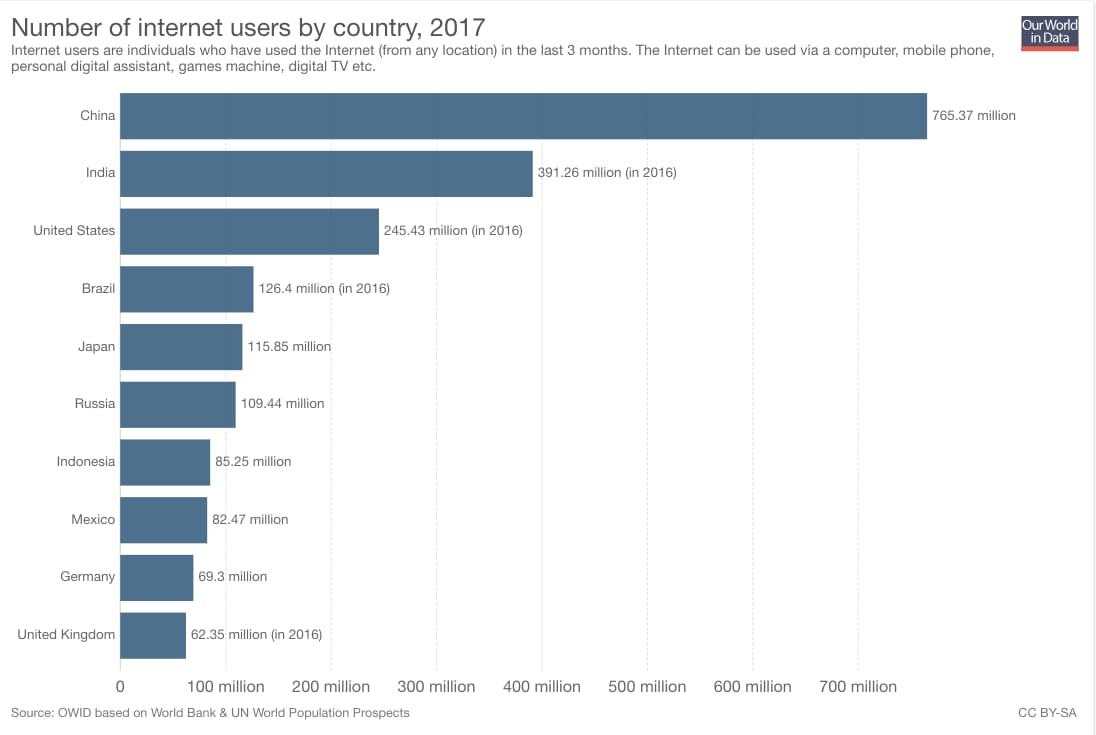
The world wide web is 30 years old this year. On 12 March 1989, Sir Tim Berners-Lee published his proposal for connecting information together so that it could be easily shared and accessed, describing how a “‘web’ of notes with links (like references) between them is far more useful than a fixed hierarchical system.” But the astronomical growth of the web could also be its downfall, Berners-Lee warns.
To commemorate its inception, and explain some of its creator’s concerns, here are eight things we think everyone should know about the world wide web, its past and its possible future.
Image: OWiD
1. Stop calling it the internet, please
The internet and the world wide web are not the same thing, even though the terms are sometimes used synonymously. The internet is a huge network of computers, including servers and data centers located all around the world – quite literally hundreds of millions of them. The world wide web is one of the ways people can access the information stored on the internet.
When you send emails they travel via the internet – but not via the web. If you’re a user of an instant messaging app such as WhatsApp, that uses the internet but not the web, and the same is true of services like Skype. The world wide web uses something called hypertext transfer protocol (the HTTP you’ve seen in web addresses) as the basis for communicating and distributing information.
2. It all started near the Swiss-French border
Berners-Lee was a software engineer working at the Conseil Européen pour la Recherche Nucléaire (the European Organization for Nuclear Research, or CERN) when he came up with the idea for the world wide web.
CERN was set up in 1954 and is located either side of the Franco-Swiss border, not far from Geneva. Although its initial focus was nuclear physics, the organization is now more famously associated with particle physics, and is home to the Large Hadron Collider – the world’s most powerful particle accelerator.
3. It might have been called the Mish Mash Mesh
OK, that’s clearly an exaggeration on our part. But one of Berners-Lee’s early suggestions for the name of his “web of notes with links” was the Information Mesh. He also considered calling it the Information Mine, or the Mine of Information.
It’s hard to imagine a world where no one ever had to struggle saying “double-u, double-u, double-u, dot” all the time. But it nearly happened. Strictly speaking, there is no need to use www. at the start of a web address – it will work fine without it. It’s a convention or habit that’s stuck. Its purpose was simply to act as a marker that a web server was in use.
4. It almost never happened
When Berners-Lee submitted his idea, his then manager at CERN, Mike Sendall, wasn’t immediately sold on the idea. He described it as “vague, but exciting.” Exciting enough that he didn’t object to Berners-Lee developing his ideas further. But that didn’t happen until the following year. However, by October 1990, he had completed three of the world wide web’s most important, and enduring, components:
A) HyperText Markup Language or HTML. This is the series of formatting tags and codes used on the web to pull information together and create links. It is also used to change the way information looks. For example, to make the word penguin appear bold you would include the following HTML tags, penguin.
B) Hypertext Transfer Protocol or HTTP. This is a protocol – an agreed and standard way of doing something. In this case, it’s referring to the way information residing somewhere online is connected to, how it links to other resources, and how it is then delivered to the user’s screen across the web. Other protocols are used for other services that work over the internet. In the case of email, for example, you will find MAILTO to indicate which protocol is in use.
C) Uniform Resource Identifier or URI. You can think of this as a unique address used to identify the location and properties of each resource available on the internet. This is particularly relevant here because it allows for instant identification of information on the world wide web. You may be familiar with the term URL (uniform resource locator). It’s a form of URI. Let’s look at this example of a URI: https://www.weforum.org/ to understand how it works. HTTPS – tells you this is hypertext-based, therefore it’s on the web. If it said FTP instead, you’d know it was a file transfer site. The S indicates encryption is being used for additional security.
5. You can still see the early web
The very first website was info.cern.ch. It was hosted by CERN, on Berners-Lee’s desktop computer. You can still view it if you follow this link.
By 1991, Berners-Lee began to realize the importance of making the web an open platform, saying: “Had the technology been proprietary, and in my total control, it would probably not have taken off. You can’t propose that something be a universal space and at the same time keep control of it.”
In 1993, Berners-Lee and CERN announced that the code used to build the web would be freely available for anyone and everyone to use. It was that move that sparked the growth of the world wide web we all use today.
Many businesses operating online have been collecting user data for years, and while most of us are happy to exchange data for free access to services, there are now huge amounts of personal data in the hands of commercial entities. This has created a global surveillance culture, Berners-Lee warns, which endangers free speech, makes life easy for repressive regimes and even puts lives at risk. It could be one of the factors that contribute to the web stagnating.
7. The contagion of fake news
On Twitter, false information spreads six times faster than the truth and is far more likely to be shared around. Partly that’s because of the deliberate use of bots and fake accounts to help with the spreading. But it may also have something to do with the salaciousness of some fake news and how that appeals to people. Either way, it undermines trust and trust is hugely important if the web is to remain a viable platform going forward.
8. The splinternet
Perhaps the most significant threat to the web – and without doubt, the most existential one – is the development of something most commonly referred to as the splinternet. This refers to the possibility of the web (and indeed the internet in its entirety) being broken into smaller, regional pieces.
In part it is a reaction by some national governments to what they see as the undue influence of a small number of tech giants. As those national governments implement different levels of regulation, the very idea of a world wide web is cast into doubt. What was once envisaged as a seamless, borderless, even playing field offering a uniform online experience for everyone no matter who they are, will be no more.
Share
License and Republishing
World Economic Forum articles may be republished in accordance with our Terms of Use.