https://www.climatechangenews.com/2019/12/14/australia-brazil-carbon-credits-will-put-1-5c-reach-ten-countries-say/
Australia and Brazil carbon credits will put 1.5C out of reach, 31 countries say
Group led by Costa Rica publishes ‘minimum’ standards for carbon markets that rule out double counting and use of Kyoto-era credits
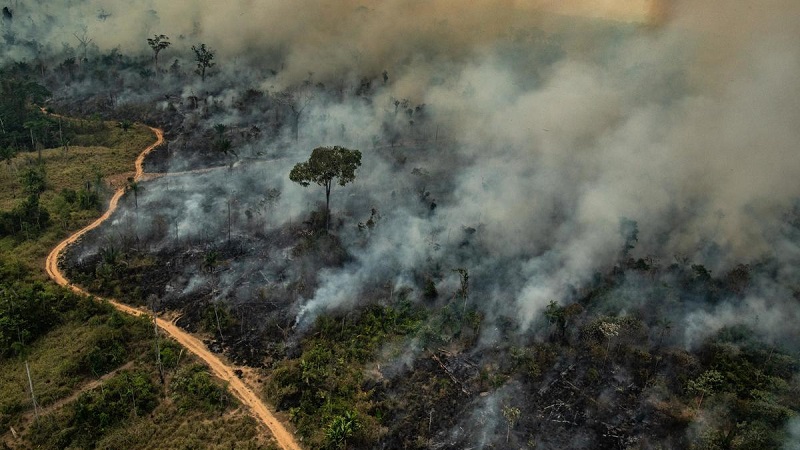
Aerial picture of wildfires in the city of Altamira, State of Para, Brazil (Photo: Victor Moriyama /Greenpeace)
Carbon market rules being pursued by Australia and Brazil are not in line with the 1.5C temperature goal of the Paris Agreement, according to 31 countries who broke from tense discussions at the UN climate talks in Madrid.
Led by Costa Rica, they published a set of 11 benchmarks they said represented the “minimum” standard to ensure integrity of the global carbon trading system due to come into effect next year.
The ‘San Jose principles’ were signed by 30 other countries including France, Germany, the UK, Spain and New Zealand.
Carlos Manuel Rodriguez, Costa Rica’s environment minister, said the principles present “a definition of success” on the new carbon market rules and “keep the door open” for limiting warming to 1.5C.
“Anything below these San Jose principles won’t create a fair and robust carbon market,” he said. “The diverse group of countries supporting these principles know we need a just outcome to keep the 1.5C target within reach.”
The principles rule out ‘double counting’ and the use of credits from the Kyoto Protocol-era system that is being superseded. The principles don’t explicitly name any countries., but the former is a position being pursued by the Brazilian government while Australia is the only country openly planning to use Kyoto credits to meet its 2030 emissions goal.
The publication of the principles during ongoing negotiations at the Cop25 talks indicates the level of frustration among countries seeking strong rules. Earlier on Friday, Rodriguez named Australia, Brazil and the US as countries pushing “totally unacceptable” positions.
The principles also say the market must achieve an “overall mitigation” in global emissions and should be assessed using transparent, publicly accessible accounting methods.
They didn’t include language on human rights in communities affected by pro-climate developments. Those safeguards have been eroded and appear to have few champions among the governments at the Madrid talks.
The principles were initially agreed at the pre-COP negotiating session held in October in San José, Costa Rica, but only released now as the carbon markets talks continue to stall at the ongoing summit.
“If markets are to increase ambition, the rules have to be as robust as the San Jose Principles,” said Franz Perez, Switzerland’s lead climate negotiator.
The group, which calls itself the Unconventional Group, also includes Paraguay, Perú, Vanuatu, Luxembourg and the Cook Islands. They are encouraging other countries to join the coalition.
The release of the benchmarks comes as the climate talks spilled into Saturday in a bid to find agreement on several key points of dispute. At the time of writing, a stock-taking plenary was scheduled to take place at 8am this morning, followed by a closing plenary at 9am. This is likely to change, however.
NOTE: This story was updated to reflect the changing number of countries in the group. The full list is here.


沒有留言:
張貼留言