http://www.bbc.com/news/business-40186774#
Organic milk not good for the land, says ad watchdog
 GETTY IMAGES
Buy a pack of organic milk and generally you feel you have done the world and the environment a service - albeit a small, litre-sized one.
After all, you think, a happy cow in a grassy field is probably a good thing, environmentally speaking.
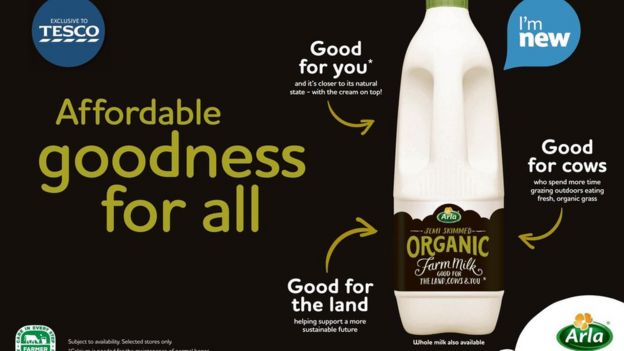
Which is probably why Arla decided to say its organic milk was "good for the land" and "a more sustainable future".
But the Advertising Standards Authority (ASA) said the claim was "misleading" and has banned the ad.
Arla placed its ad in a local paper in November last year and someone, known simply as "the complainant", reported it to the ASA.
Arla Foods is no small-scale outfit. It is a massive European milk co-operative ranked as the fourth-largest milk producer in the world.
It owns the Anchor and Cravendale brands and has a long history, with roots in the UK's Express Dairies and the Swedish and Dutch dairy industry. It now has annual revenues of 9.6bn euros (£8.4bn).
Evidence
It duly gave its evidence to the ASA and explained one of the key principles of organic farming was good treatment of the land and that sustainability was at the heart of organic farming.
The impact on the environment, it said, was considered in every step of the production process.
Quite so, replied the ASA, but that's not the same as "good for the land".
This is what the ASA said: "We did not consider [Arla] had substantiated that organic milk production had an overall positive impact on the environment, taking into account its full life-cycle."
The key problem here is not that the ASA thinks that organic milk is not all it's cracked up to be.
It's saying that Arla simply failed to prove that it was good for the environment, specifically through its "full life-cycle", taking into account milk's total environmental impact.
 ADVERTISING STANDARDS AUTHORITY
Organic farms
The argument for organic milk is not as straightforward as you might imagine.
Organic dairy producers do feed their animals with crops grown without the use of synthetic pesticides. They don't use antibiotics. They use less energy in producing and carting around concentrates. All those are plus points.
But organic farms produce less milk per head of cattle. So they use more land and more cows per litre. And there is the awkward matter of methane, a greenhouse gas, which cows produce in abundance.
An OECD report on the international dairy industry said: "Organic farms perform better in terms of soil and water quality, and species biodiversity, but can perform worse in terms of methane emissions."
It added: "While the environmental pressure from organic farming was less on a per-hectare basis, the difference between systems reduced substantially when measured on a per unit of output basis."
The ASA added in its judgement "that consumers would interpret the claim 'good for the land … helping to support a more sustainable future' to mean that the production of the advertised organic farm milk was undertaken in such a way that it would have an overall positive impact on the environment, taking into account its full life-cycle. "
And that, according to the ASA, was misleading, so the ad came down.


沒有留言:
張貼留言