http://e-info.org.tw/node/117091
消耗量全球第二高 摩洛哥7月起禁用塑膠袋
文字大小
724 1 Share1
本報2016年7月15日綜合外電報導,姜唯編譯;蔡麗伶審校
摩洛哥7月1日起禁止生產和使用塑膠袋。不過環團表示,摩洛哥人可能還需要幾年的時間才能完全遵守新法令。
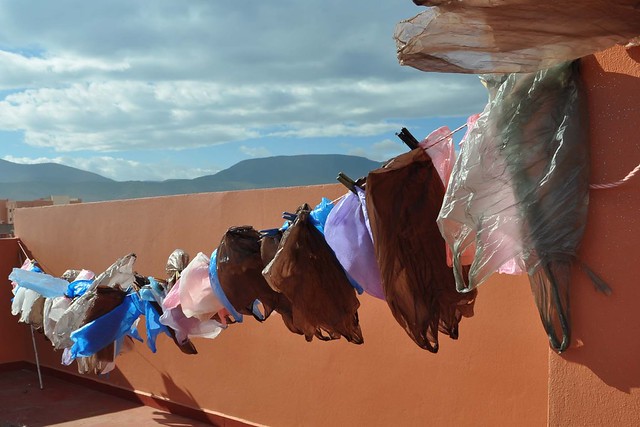
摩洛哥曾是世界第二大塑膠袋消耗國。圖片來源:Relation Presse Maroc & Communiqués Maroc。
COP22主辦國 摩洛哥躋身最環保開發中國家
摩洛哥和哥斯大黎加、不丹、衣索比亞一樣,是全世界最環境友善的國家之一,部分原因是他的減碳目標相當積極。近期的永續措施,讓摩洛哥躋身最環保的開發中國家,全球氣候大會(COP22)也將在今年11月於摩洛哥馬拉喀什市舉辦。
根據半島電視台報導,摩洛哥國會去年10月通過指標性新法案,全國禁止塑膠袋的生產、進口和銷售。但是越接近今年7月1日,全國商店、街頭小販和零售業倉促囤積著可再利用的塑膠袋。他們表示,改變並不容易。
摩洛哥與塑膠袋的角力已經持續好幾年。街頭常見丟棄的黑色塑膠袋,已在2009年禁止生產和使用,但是努力尚未成功,非正規的生產活動仍然抓不勝抓。
市場趕不上政策 塑膠袋禁用非一蹴可幾
摩洛哥是全世界第二大塑膠袋消耗國,僅次於美國。根據官方統計,該國每年使用30億個塑膠袋,等於3400萬人口,平均每人每年使用900個塑膠袋。
法案起草人、工業部長埃拉拉米(Moulay Hafid Elalamy)在社群網站推特上表示,將有普及的替代方案,如紙袋和布袋,此外也強調「冷凍袋」不在禁用範圍內。
但是聯合國自2012年起對摩洛哥的環境保護進度審查發現,「摩洛哥未能著手解決環境問題,而這些問題可能逐漸變成經濟和發展問題。」
根據2013年德國國際合作協會(German Society for International Cooperation)的研究,摩洛哥城市只收70%的固體垃圾。世界銀行也指出,收集來的垃圾中只有不到10%被以「環境和社會方面可接受的方式」處理。
當地倡議組織Mawarid會長Yassine Zegzouti表示,摩洛哥要全面禁用塑膠袋不是不可能,最難的部分在於改變消費習慣。「正規市場需要四到五年才能完全做到。」Zegzouti說。

MOROCCO
Going green: Morocco bans use of plastic bags
As Morocco's ban on plastic bags comes into effect, green campaigners worry consumers will need time to change habits.


Rabat, Morocco – As a ban on the production and use of plastic bags comes into effect across Morocco on Friday, green campaigners say that the country's consumers may need years to fully comply with the new law.
A landmark bill passed by the Moroccan parliament last October banned the production, import, sale and distribution of plastic bags across the country.
The bill, which became law on July 1, is part of a larger environmentally conscious effort across the North African country to go green.
Morocco ranks alongside Costa Rica, Bhutan and Ethiopia as one of the world’s greenest countries, a fact partially due to its ambitious goals to crackdown on carbon emissions.
Recent sustainability measures have turned the country into a green leader among developing nations, and the city of Marrakesh is due to host a global climate change conference in November 2016.
But as the July 1 deadline approached, shops, street sellers and retailers across the country scrambled to stockpile reserves of reusable bags. The change, they say, will not be easy.
The country’s battle with the plastic bag has been in the works for years. Efforts in 2009 to ban the production and use of black plastic bags, which litter the country’s streets and beaches, were only partially successful, as authorities struggled to curtail informal production of the bags.
Morocco is the second-largest plastic bag consumer after the United States. It uses about three billion plastic bags a year, according to the Moroccan Industry Ministry. That means, on average, that each one of Morocco’s 34 million people uses about 900 bags a year.
A blanket ban on the use of plastic bags will take some getting used to, says Jennie Romer, a New York-based lawyer.
“It's a big cultural shift with that type of broader law,” she said. “As long as the government has the motivation to really enforce that. There is a lot of potential. The government entity that is implementing it has to be completely on board in order to make that really happen in practice.”
While Industry Minister Moulay Hafid Elalamy, the initiator of the bill, did not return requests for comment, he said on his Twitter account that “several alternative solutions” will be made widely available, such as bags made of paper and fabric. He added that “freezer bags were excluded.”
For weeks now, awareness campaigns throughout the country have been warning Moroccans against the use of bags, which take hundreds of years to degrade. Their message is simple: plastic bags are unhealthy and dangerous for the ecosystem in a country that struggles to clean its streets and where fields of rubbish plague the local environment.
“They do it to promote the image of Morocco as an environmentally friendly country, which is partly true, but not completely,” Mamoun Ghallab, a sustainable development consultant, told Al Jazeera during a recent beach clean-up event in Casablanca.
Ghallab said the government hasn’t done much to raise environmental awareness. Some campaigns about littering have been done, he added, but their cartoonish design made them only marketable to children.
“If citizens are not aware of the concerns and the challenges we’re facing, things will go much slower,” Ghallab said. “Everything begins and ends with the citizens.”
But the UN Environmental Performance Review of Morocco, which has analysed the country’s environment protection progress since 2012, reported that Morocco “fails to address environmental challenges, which can gradually become economic and development challenges”.
Moroccan cities only collect 70 percent of solid waste, according to a 2013 study released by the German Society for International Cooperation. And the World Bank has reported that less than 10 percent of collected waste is disposed of in an “environmentally and socially acceptable manner.”
Yassine Zegzouti, 30, president of local advocacy organisation Mawarid, said it is possible for Morocco to totally ban plastic bags, but that changing consumer habits will be the most challenging part.
The government has shown a commitment to putting the ban into practice, he said, not only through TV spots encouraging citizens to change their habits, but also by investing millions of Moroccan dirhams into encouraging the industry to transform their production of the bags.
“The formal sector will need four to five years to comply with the new law,” said Zegzouti.
“But the use of plastic bags is anchored in [consumer] habit,” said Zegzouti. “All actors need to change these habits to not have any damage in the future.”
This story was produced in association with Round Earth Media. Elaina Zachos contributed reporting.


沒有留言:
張貼留言